William Billingsley
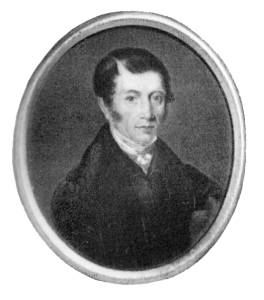
The Flower Painter
The ‘Flower Painter of Derby’ believed by many to be William Billingsley. Image Royal Crown Derby Museum.
Early Years
William Billingsley was born in Derby in 1758. He was apprenticed at the William Duesbury Derby China Works 1774. In November 1780 William Billingsley was married to Sarah Rigley at St Alkmunds church in Derby. They had three children: Sarah born in 1783, James, who died in his infancy born in 1793 and Lavinia born in 1795.
His work
He is particularly associated with the rose which he painted in all its aspects. He introduced the new style of painting known as the wiping out process when painting flowers. The ‘Prentice Plate’ was used in the Derby factory as an example of the standard that was expected of new apprentices.
After experimenting in firing porcelain in a small kiln installed at his home, Billingsley decided to leave Derby in 1795. Be the decoration so fine, its beauty could never otherwise but be marred by an inferior body and this Billingsley knew well.
He moved constantly and worked at a number of different potteries. At Torksey, Lincolnshire he first came into contact with Samuel Walker, who later married his daughter Sarah in 1812. The family arrived at Flight Barr and Barr’s porcelain factory at Worcester and between 1809 and 1812 Billingsley was instrumental in refining its porcelain recipe whilst Walker developed new kiln designs.
Their departure from Worcester was abrupt and followed the end of their period of contract. Billingsley and Walker were bound by the owners in the sum of £1,000 not to disclose to any third party details of the ‘new method of composing porcelain’ which they had developed at Worcester.
The Flower Painter
The ‘Flower Painter of Derby’ believed by many to be William Billingsley. Image Royal Crown Derby Museum.
Nantgarw
Their arrival at Nantgarw late in 1813 and the subsequent story can be followed elsewhere on this site.
Following his departure from Nantgarw, Billingsley worked for the Coalport China factory. He died on 16th January 1828, almost unmourned and was buried in an unmarked grave in the parish of Kemberton near Coalport.
The Pardoe Family
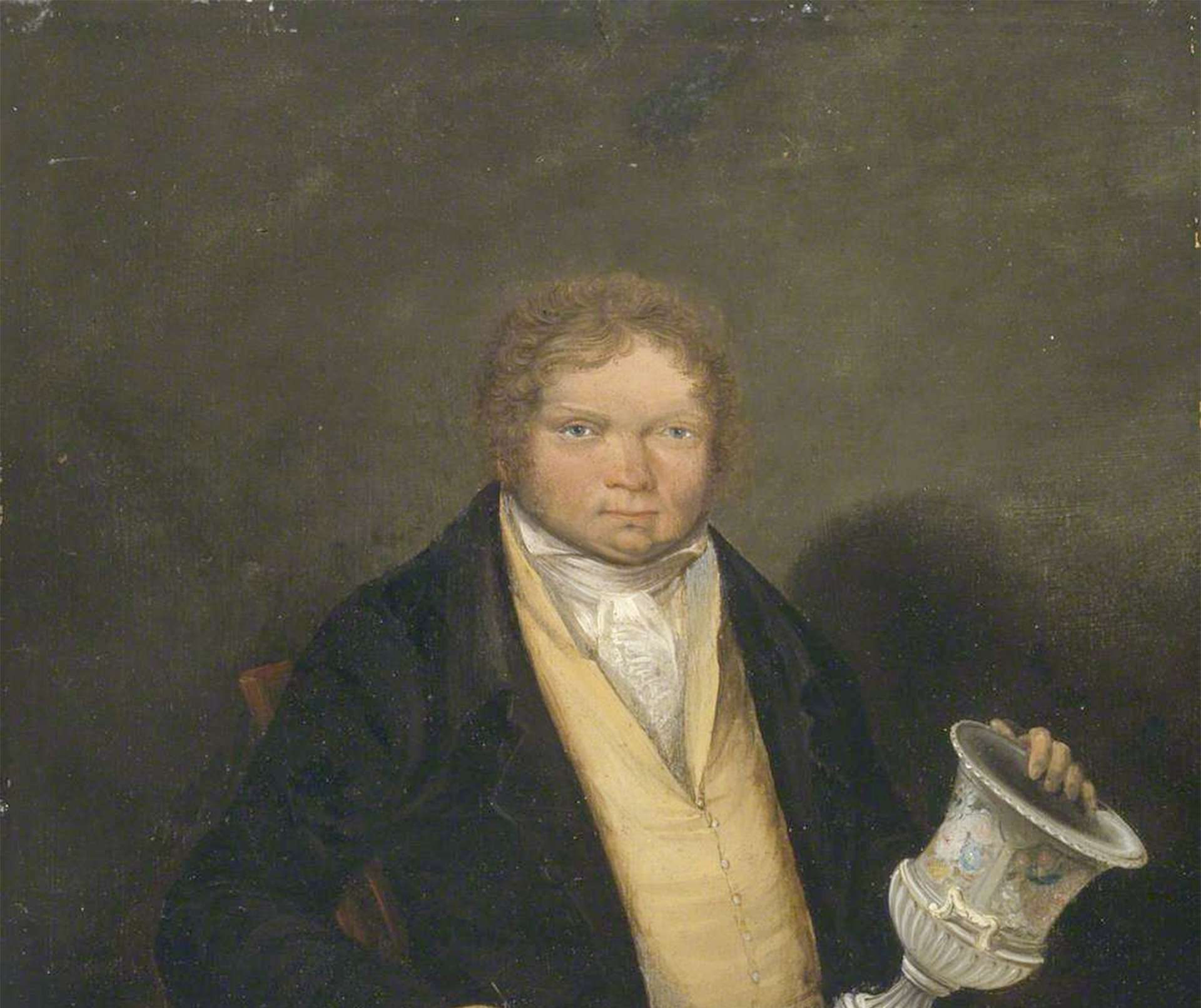
Thomas Pardoe
(probable self portrait) c 1810-20. National Museum,Wales
After Billingsley and Walker
When William Billingsley and Samuel Walker left Nantgarw there remained a considerable quantity of undecorated ‘in the white’ porcelain. William Weston Young, in order to recover some of his loses bought the remaining stock and equipment and invited enameller and decorator Thomas Pardoe from Bristol to decorate the porcelain.
For the next two years Thomas Pardoe helped by his son William Henry decorated the porcelain. Thomas Pardoe was a noted painter of flowers and birds on porcelain and earthenware and had worked as a ceramic painter at Derby, Worcester and Swansea. He was familiar with and a great admirer of Nantgarw porcelain.
The aim was to produce more modestly priced porcelain for sale in the local market. Despite their simplicity they are full of charm. A final sale took place at the Nantgarw works in October 1822.
Thomas Pardoe remained at the Nantgaw until his death in July 1823. He is buried in Eglwysilan church which is also Lavinia’s resting place.
Over the next ten years the factory remained closed while William Henry Pardoe plied his trade in Cardiff as a China and glass enameller as well as a retailer of clay pipes.
Thomas Pardoe
(probable self portrait) c 1810-20. National Museum,Wales
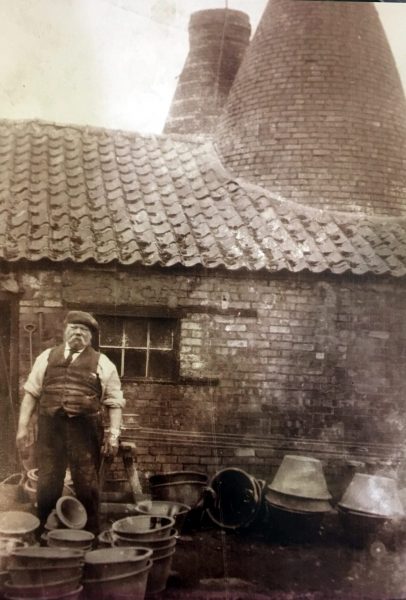
Percival Pardoe circa 1900
1833 William Henry returned to Nantgarw on a new lease and established ‘The Old Nantgarw China Works’ manufacturing salt glazed stoneware bottles and brown glazed earthenware. New kilns were built and the factory also made very large quantities of clay pipes
William Henry and his wife Mary had a large family of fourteen children although several died in their early years. Upon William’s death in 1867 the business was taken over by his widow and younger sons. Percival Pardoe continued to run the factory until his death in 1920. By this time the introduction of cigarettes had killed the market for clay pipes and the factory closed.
Descendants of the Pardoes continued to live in Nantgarw House until the 1970s after which the house and former China Works site were abandoned and fell into disrepair.
Porcelain Production
What makes Nantgarw Porcelain special?
Nantgarw China Works is the only surviving early 19th century porcelain works in the United Kingdom. In the years 1813-1814 and again in the period 1817-1820 the finest porcelain in the world was produced here in Wales by William Billingsley, one of the most remarkable porcelain painters and manufacturers of his time.
What is porcelain?
Porcelain is a vitrified (glass-like) ceramic with a white, fine-grained body that is usually translucent, as distinguished from earthenware, which is porous, opaque, and coarser.
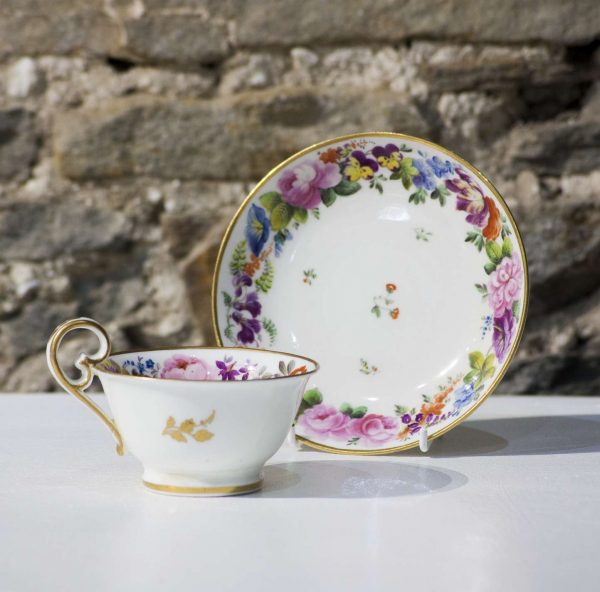
Cup and Saucer set from Nantgarw Collection
Types of porcelain
There are two main types of porcelain:
- Hard-paste porcelain typically the type of porcelain made by the Chinese for more than a thousand years. This is extremely hard, can be slightly gray in colour and has some translucency. It needs to be fired at high temperature.
- Soft-paste porcelain dates back to early attempts by European potteries in the 18th century to replicate Chinese porcelain by adding a ground glass type substance (known as a frit) to china clay. This porcelain is softer, can be fired at lower temperatures but often lacks strength being prone to collapsing during firing. It is expensive to make due to extra firing costs of the frit and relatively expensive ingredients.
There is also a hybrid – bone china which combines bone ash to hard paste porcelain ingredients to giver a whiter more translucent body and added strength and which can be fired at lower temperatures than hard-paste porcelain.
Nantgarw Porcelain
At Nantgarw William Billingsley perfected his porcelain recipe with the addition of a variety of ingredients known only to him He succeeded in producing the finest porcelain ever made.
Nantgarw Porcelain is unique in that it is a bone ash/frit based soft-paste porcelain body which no other porcelain can come close to in translucency or whiteness. Furthermore, the glaze on Nantgarw porcelain is the perfect complement to enamelled decoration giving the colours true vibrancy and allowing the decoration to merge into the glaze.
Pottery and Pipes
Lorem Ipsum Dolor
Praesent a nisl id est porta porta. Class aptent taciti sociosqu ad litora torquent per conubia nostra, per inceptos himenaeos. Etiam vitae vulputate eros. In eget lacus posuere nibh sagittis maximus. Praesent ut iaculis dolor, eget imperdiet metus. Donec porta pharetra arcu, a elementum felis porta id. Vivamus nibh turpis, varius in erat porta, fringilla sodales tortor. Fusce rhoncus lorem quis dolor consequat, at sodales lectus gravida. Suspendisse potenti.

Lorem Ipsum Dolor
In eget lacus posuere nibh sagittis maximus. Praesent ut iaculis dolor, eget imperdiet metus.
Lorem Ipsum Dolor
Praesent a nisl id est porta porta. Class aptent taciti sociosqu ad litora torquent per conubia nostra, per inceptos himenaeos. Etiam vitae vulputate eros. In eget lacus posuere nibh sagittis maximus. Praesent ut iaculis dolor, eget imperdiet metus. Donec porta pharetra arcu, a elementum felis porta id. Vivamus nibh turpis, varius in erat porta, fringilla sodales tortor. Fusce rhoncus lorem quis dolor consequat, at sodales lectus gravida. Suspendisse potenti.
Lorem Ipsum Dolor
Praesent a nisl id est porta porta. Class aptent taciti sociosqu ad litora torquent per conubia nostra, per inceptos himenaeos. Etiam vitae vulputate eros. In eget lacus posuere nibh sagittis maximus. Praesent ut iaculis dolor, eget imperdiet metus. Donec porta pharetra arcu, a elementum felis porta id. Vivamus nibh turpis, varius in erat porta, fringilla sodales tortor. Fusce rhoncus lorem quis dolor consequat, at sodales lectus gravida. Suspendisse potenti.
Modern History
Artists in Residence
Nantgarw China Works is still extremely active in encouraging, supporting and promoting contemporary artists working with ceramics. The China Works currently provides studio space and facilities to outstanding ceramicists who create, fire and exhibit new work on the premises. These artists actively pass on their skills to both adults and children through regular workshops at China Works.
In 2017 Nantgarw China Works undertook a project to recreate the original recipe for Nantgarw Porcelain which had been lost for over two hundred years. This successful completion of this project has enabled our current artist in residence to start making new contemporary work from this exceptional porcelain body. A small number of items made from this porcelain will be sold to help support the sustainability of the museum.
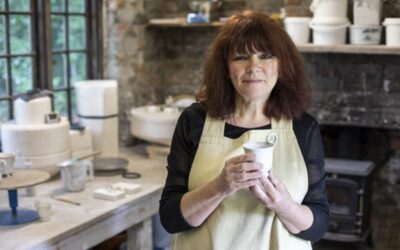
Sally Stubbings – Ceramicist
Sally Stubbings is the principal ceramicist at Nantgarw China Works and has been instrumental in rediscovering and recreating the original recipe for Nantgarw Softpaste Porcelain. Well rounded in all aspects of ceramics her primary focus is on porcelain which is...
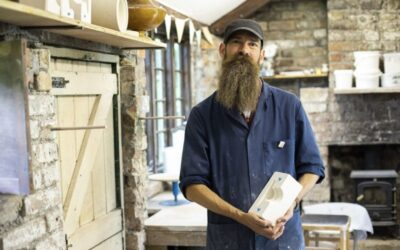
Huw Raine – Mouldmaker
Huw Raine is the resident mouldmaker at Nantgarw China Works developing traditional plaster of paris moulds for slipcasting Nantgarw Porcelain. He also offers bespoke ceramic design consultancy, servicing potteries, product designers and architects. Specialising in...
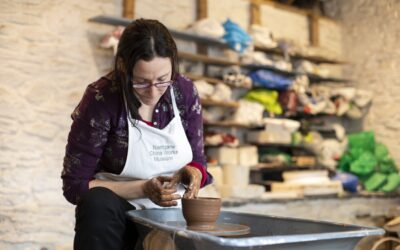
Freya James – Thrower
Freya is a senior ceramics instructor at Nantgarw China Works and an accomplished thrower on the wheel.